
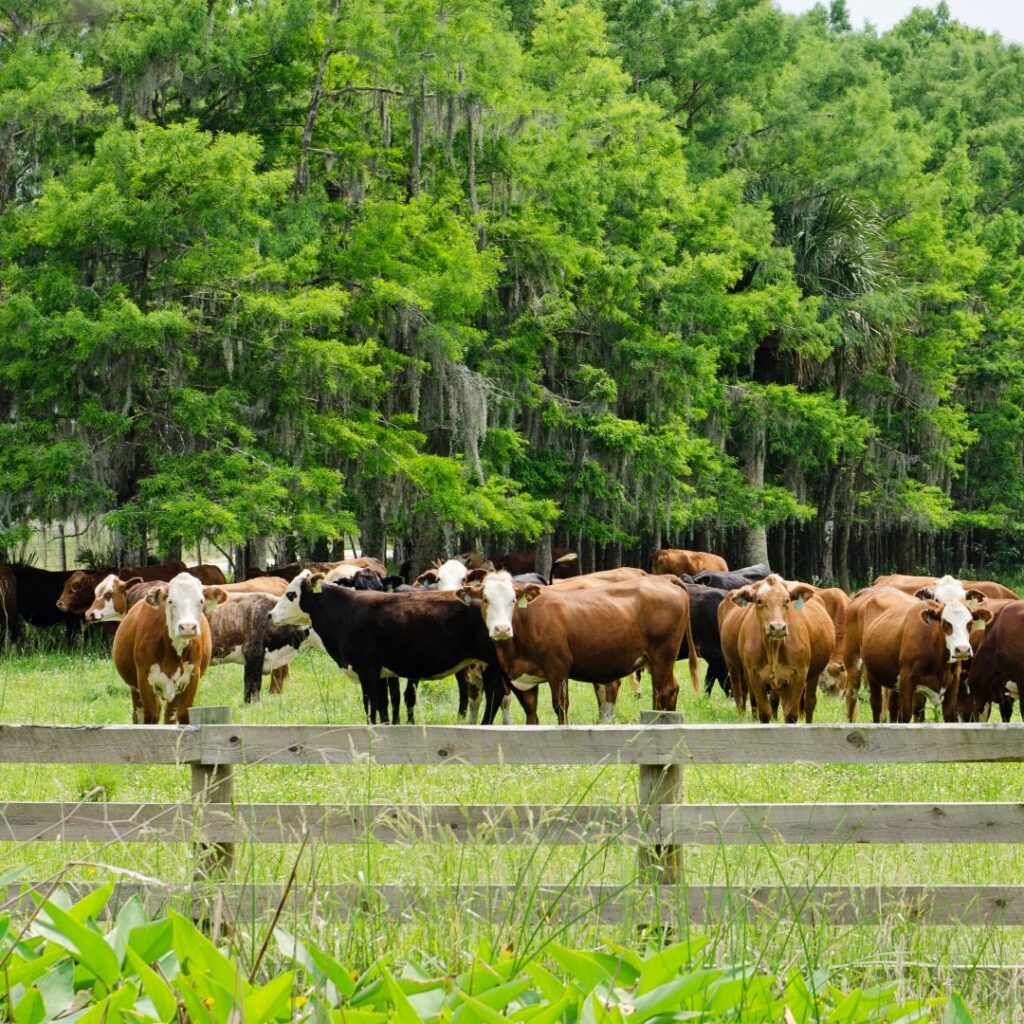
In Summer 1952, Morris Justesen and his family arrived in Central Florida, one of 12 Nevada cattle families asked to sell everything and move to Deseret Ranch. It was June, the average high was about 96 degrees, and the humidity ranged from muggy to miserable, most often settling in at oppressive.
“Air conditioning was not common then,” long-time-ranch-employee-and-resident Debbie Justesen said. “It was hot, humid, and sticky. There were bugs and snakes. My father-in-law looked at his wife and said, ‘I have moved you to hell.’ ”
That sentiment, however, did not last long. “Within two weeks, it was home,” said Debbie, who worked at the ranch for 38 years, mostly as an executive assistant.
Visionary Beginning
This year has been a big one for the ranch. As it celebrates its 75th anniversary, Deseret Cattle & Citrus (DCC) was featured as the subject of a stunning 38-minute episode of “Cattle Calling,” a documentary series produced by the National Cattlemen’s Beef Association and funded by The Beef Checkoff.
Founded in 1950, the ranch began with the purchase of five large tracts of mostly cut-over timberland and low-quality wiregrass range land. At the time, few saw potential in the sandy soil and harsh conditions. Former General Manager Erik Jacobsen recalls, “I’ve always thought it was visionary that some guys from Salt Lake City started buying land in Florida in 1950. The ranch has gone through a lot to get where it is today.”
That vision has grown into one of America’s largest and most innovative ranching operations, spanning about 300,000 acres between Orlando and the Space Coast and home to about 45,000 cows.
The ranch has long been a model of sustainable environmental management. Forward-thinking practices protect groundwater, preserve diverse habitats, support one of Florida’s largest Wood Stork rookeries, and led to the creation of the award-winning Jug Island Reservoir for stormwater retention and treatment. In addition to forestry, sod, and shell bed mining operations, land is leased for utility-scale solar projects to help meet growing regional energy needs, all while ensuring long-term stewardship of soil, water, and wildlife.
Growing People
There are 95 to 100 full-time employees at the ranch, and for many, it is more than a workplace: It’s a life-changing, life-shaping experience.
That’s certainly the case for current General Manager Parker Ussery. “I think as far as me and my family are concerned, this place has changed our whole life,” he said. “It has impacted us from the things that we do every day, to the way of life that’s important to us, to the growth that I’ve seen in my kids … all of that I owe to this place.”
Parker joined AgReserves in 2015 as a transaction manager after working for USDA’s Natural Resources Conservation Service in Oregon.
While working toward his MBA, Parker spent a summer at the ranch, fell in love with Florida, and figured he’d return in some way – possibly as government affairs manager – if he could. He got his chance after graduating in 2019. “It ended up our stars kind of aligned, and I had an opportunity to come as an area manager. That was a dream come true for me.”
Parker quickly moved from overseeing the south end of the ranch to being named Assistant GM and then being selected as GM earlier this year.
“It’s like the ultimate life accomplishment. In the office, there’s a wall that has the general managers on it, and to be in the ranks of leaders as qualified as those guys … to have an opportunity to be in the ranks of such huge contributors to the industry, not just the ranch but drivers and influencers across the whole cattle industry, that’s incredible to me.”
▪▪▪
Erik is one of those GMs up on the wall. He first encountered the ranch as a fencing contractor at age 18, before he even knew its name. After graduating from the University of Florida, he joined the ranch as a cowboy in 1986. From there, he rose through the ranks to become not only General Manager but also Vice President of AgReserves’ Ranches Division. In those roles, he led efforts to protect the ranch’s interests with long-range sector plans to address future regional growth.
“The ranch had more of an impact on me than I had on it in the early years,” Erik says. “It shaped my career, my education, and even my family.”
Encouraged by leadership, he earned an MBA at BYU where he met his wife, Renée. “So yeah, the ranch has had a big impact on me. I’ve done just about every job there, and it was a wonderful place to raise our kids.”
Erik has a new job now; he’s the Vice President of AgReserves’ Land Management Team and works at headquarters in Salt Lake City.
▪▪▪
Clint Richardson, VP of the Ranches Division since 2022, started at DCC as a cowboy in January 1999, when he and his young family moved into a wood-framed house on the south end of the ranch, a place that remains deeply meaningful for him.
“That’s just a special place to me, to look back at those first few months, those first couple of years, to learn the culture and be part of something that was obviously way bigger than myself,” Clint said. “We never could have imagined where we’d end up today.
“You’d never dream that, working in the industry, you’d have an opportunity to manage something like Deseret Cattle & Citrus,” he continued. “I’m just grateful that at some point someone took a chance on me. I’ve been able to learn and grow in a supportive environment. I’ve had leaders and people along the way that have helped me to be better. Others have taken a chance on me, given me responsibility and trusted me to manage the resource, to be a representative of the company. I’m grateful for that trust.”
▪▪▪
Debbie, whose family moved to an adjacent cattle ranch when she was 2½, has spent most of her life not more than 30 minutes from DCC. In 1976, she took a front desk job at the ranch, planning to stay three weeks. Instead, Debbie was there for about 7½ years before stepping away for 11 years to raise her children. She returned to the office in 1995 and remained until her retirement in August 2024. In her 38 years at the ranch, she worked for seven of the GMs whose pictures are up on the wall.
“I raised my three boys here, and I can’t think of a better place to have raised them,” Debbie said. “It’s kind of like there was a bubble over the ranch; we were in the world but not of the world. I didn’t worry if my kids were down the street or in a pasture, we didn’t lock our doors, and we kept the keys in the car.”
Debbie said her favorite thing about the ranch was always the people: “Some of them are not related, but they become family. Neighbors worked together, played together, and their kids played together. It was a close-knit community. If you cried, they cried with you; if you laughed, they laughed with you. Sometimes I think there’s not as much of that in this world.”
Looking Ahead: The Next 75 Years
DCC’s three most recent GMs all believe that ranching will be at the core of the ranch’s future for the next 75 years, although they know change is inevitable.
“Seventy-five years is a long time,” said Erik, who helmed the ranch from 2006 to 2017. “It will still be a major ranching operation, but I’m sure a lot of things will change. Hopefully, what we’ve done with the sector plans will guide how that change happens, and it will be done right. I really think it will.”
“Obviously, we’ll still be ranching, and the ranch will be a solution in a lot of ways,” said Clint, the GM for eight years before handing the keys to Parker. “It will remain a key partner in addressing regional challenges – from water to growth and development – while continuing sustainable operations that fulfill our mission. We’re a long-term investment focused on enhancing asset value, feeding the world, and contributing to our communities. It’s special to achieve all of that in a way that lasts for generations.”
Parker agrees: “The program’s a sound, steady one, and 75 years from now there will be some tweaks and new science will bring new opportunities, but the program itself has been proven over enough time that this place will continue to operate for as long as we need it to.”
As for Debbie, she expects to see the beauty of the ranch remain. The Cypress and Oak hammocks, the wildlife, seeing a herd of cows under shade trees or belly deep in a pond, have all made a lasting impression on her. “It’s a slice of heaven,” she said of the ranch. “This is what heaven most surely looks like.”