
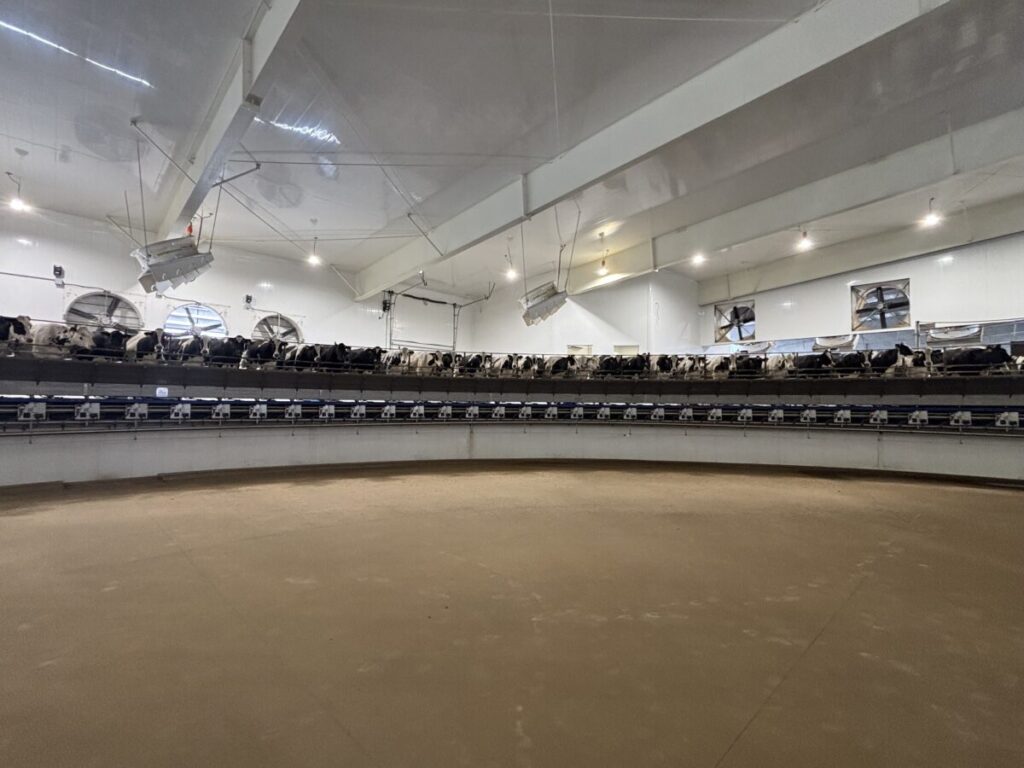
A vision years in the making became reality Dec. 2, 2025, when Elberta Valley Ag (EVA) cut the ribbon on its new rotary milking parlor, ushering in a new era for the operation. The next day, cows were milked in the facility for the first time, marking the start of a major shift in EVA’s dairy process.
“The actual build and function have been fine,” said EVA General Manager Brandon Andersen. “We’re still ironing out some automation issues, but after a month of milking, we’re learning and improving. I’m really happy with it.”
Beyond the initial learning curve, the parlor represents a major step toward EVA’s future goals.
“Brandon and his team have done a fantastic job of developing a long-term plan to ensure the parlor supports our commitment to innovation and operational excellence,” said Clint Richardson, AgReserves’ Vice President of the Ranches Division. “It’s cutting-edge technology that should reduce costs and enhance profitability. This is a great example of a project that really checks all the boxes.”
Inside the new rotary parlor
The rotary parlor, a DeLaval system, has 120 stalls. Cows enter on one side and rotate clockwise, allowing workers to stay in one place.
A cow gets on every four seconds, and the platform completes a revolution in about eight minutes. Teats are sprayed with disinfectant (robotic sprayers will be added in the next couple weeks), dried, and milkers attached. Milking takes 4 to 6 minutes, and units detach automatically using flow sensors.
At the end, cows receive a post-spray (also moving to robotics this month) to prevent bacteria and condition the teats. As cows exit the rotary, two sort gates can be used to separate cows needing attention such as artificial insemination, pregnancy checks, vaccinations, or treatment. All reproduction and health work now happens as cows leave the rotary rather than by workers going pen to pen.
Previously, milking was done three times a day in two double-40 herringbone parlors. Each parlor held 80 cows – 40 on each side – angled away from the milking pit so workers could reach their udders. The process was hands-on, requiring employees to walk the length of the pits to attach and detach milkers to about 4,600 cows over each seven-hour period. The new rotary changes everything: Cows now glide past workers, who stay in one spot.
“I think it’s the best way to milk cows,” Andersen said of the new parlor. “Anyone building a dairy now is doing a rotary parlor or robotics in the barn. For retrofitting like we did, the rotary is the most efficient and comfortable for cows.”
Boosting capacity and efficiency
With this project, EVA is adding about 800 cows, going from 5,700 to more than 6,500. Once running at full capacity, 5,400 cows will be milked three times a day on the new parlor.
“To milk the whole group of 5,400 cows takes about seven hours. Then we have an hour of downtime to wash equipment, and then we start again. It’s basically round-the-clock milking,” said Andersen.
There’s a special milking area for 400 cows that have just had calves, while another 700 pregnant cows are in a dry period and won’t be milked.
A key goal of the project was to improve efficiency in the milking process. Andersen said that by adding 800 cows, EVA can produce roughly one additional truckload of milk each day, about 70,000 pounds. These gains in productivity and streamlined operations reflect EVA’s commitment to innovation and continuous improvement.
Cow comfort and milk quality
The cows seem to like the rotary parlor, although they need to be encouraged to step on the first time because it can be scary for them.
“Once they’ve been on it once or twice, they’re much more comfortable,” Andersen said. “By the third or fourth time, they step on easily. They all face each other, so they can see other cows being milked. As social animals, they enjoy that. At first, they’re nervous and make a mess, but after about a week, the rotary stays a lot cleaner because they’re comfortable and not nervous.”
Andersen said that having a consistent milking process should improve quality and reduce somatic cell count, which is a key indicator of udder health. He also expects more production per cow, and Richardson expects the same.
“The cows are more comfortable because we’re able to handle them in a much more consistent and low-stress manner. That really leads to greater productivity,” Richardson said.”
From vision to reality
The rotary parlor project began in 2021 with tours of different brands of rotary systems nationwide, and by 2022, a plan was in place. A preliminary budget was approved in early 2023, allowing the start of design work with an architect and contractor, a process that took nearly a year.
Building plans were submitted to Utah County in April 2024, and after corrections, EVA received the permit in July. In August 2024, concrete work started, marking the real kickoff.
“August 2024 was when the project really got going,” Andersen said. “From August 2024 to the end of November 2025, it took about 16 months to complete. We aimed for a mid-October 2025 completion, so we were about six weeks behind schedule. Honestly, for a project that size, that’s not bad.”
This milestone reflects years of planning and teamwork and sets the stage for continued innovation at Elberta Valley Ag.